The most expensive mistake in selection is often invisible
Why “noise” undermines your talent decisions and how to hygienically wash it away
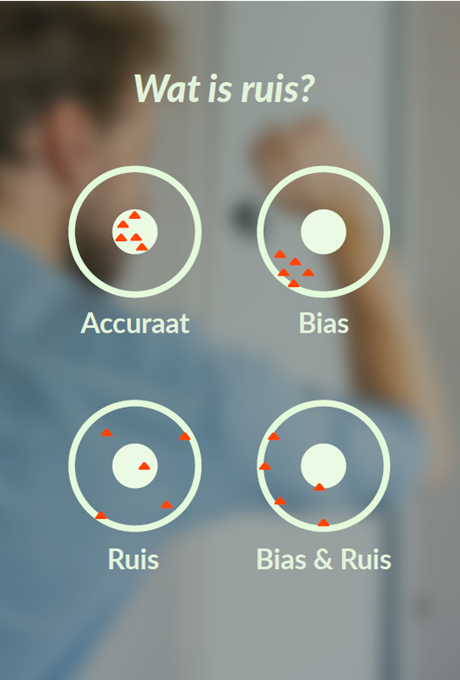
 21:06. The chair of the panel slides his paper slightly forward, as if that somehow makes it official. “I think we’ve got it,” he says. “Candidate three feels the most right.” Someone nods, someone sighs with relief, someone mutters that they “didn’t really click” with candidate two. And then something happens that occurs in almost every selection process, yet is rarely acknowledged: the verdict starts to take shape as a story. A convincing story. Built on a handful of loose observations presented as evidence. Everyone feels they are working professionally, and yet something quietly slips in that only becomes visible once you start paying attention: noise. Daniel Kahneman and his co-authors make a distinction in Noise that immediately resonates within HR. Bias is a systematic deviation: you consistently miss the mark in the same direction. Noise is something else: random variability. People you would expect to reach the same conclusion end up in very different places. Not because they are careless. Not because they have bad intentions. But because human judgment naturally shifts with context, timing, comparisons, fatigue, and even the order in which a conversation unfolds. Kahneman uses an image that sticks with you. Imagine four teams shooting at the same target with the same rifle. One team shoots tightly in the centre (accurate). One team consistently misses on the same side of the target (bias). One team shoots all over the place (noise). And one team does both. Then he turns the target around: in selection, we often only see the back side. We do not know who the “right” candidate is at the moment we make the decision. That makes noise especially dangerous, because it can effortlessly disguise itself as professionalism.
In HR, noise is often called “difference in interpretation”
Within organisations, noise rarely gets called by its real name. It enters the room as “a different style”, “a matter of taste”, “I felt something was missing”, or “not really my type of leader”. Friendly expressions, often spoken with the best intentions. Kahneman defines it sharply: unwanted variability in judgments that should actually be the same. In Noise, examples are drawn from medicine, youth care, criminal justice, asylum decisions, and insurance. Time and again, the same pattern emerges: the same case, a different decision, without the system having a solid explanation for it. Translate that to recruitment and you get the selection version of “roulette”: the same candidate, a different panel, a different outcome. And that is exactly what makes noise so expensive. Not only because of mis-hires, but also because of missed hires — candidates who could have been a perfect fit, but who happened to be in the wrong conversation, compared against the wrong person, at the wrong moment, and therefore ended up being “almost, but not quite”.
Why organisations struggle to recognise noise
Bias can sometimes still be “explained” through a cause-and-effect story. Noise is statistical. You need at least two assessments to detect it. And as humans, we are far more wired for stories than for variability. We remember that one sharp answer, that moment of doubt in someone’s eyes, that single sentence that lingered. We rarely notice the silent variability: how someone else may weigh those exact same signals entirely differently. This explains why noise often remains undiscussed, even though it contributes just as much to errors as bias does. Kahneman uses a simple logic for this: total error consists of both bias and noise. Reduce noise, and you improve the quality of decisions just as much as when you reduce bias. And no: “we decide as a group” is not an automatic guarantee. Group discussions can actually increase noise. Because the first person to speak sets the frame. Because we are social beings. Because, without realising it, we start collecting arguments that fit the first narrative. In panel settings, you can watch this happen live: one person says “too polished” or “not enough leadership”, and suddenly everything that follows is coloured by that remark. Not because people are malicious. But because the brain craves coherence.
The uncomfortable truth: confidence is not proof of accuracy
There is another layer that makes this difficult. Professional certainty feels good. The “internal signal”, the feeling that you have arrived at a coherent conclusion, is emotionally rewarding. The brain says: good, complete, we’re done. But that feeling mainly tells you that your story is coherent. Not that your decision is correct. In selection, you immediately recognise it in phrases like: “I can’t prove it, but I feel it.”; “I’ve seen this a thousand times before.”; “He’s strong, but… something.” These sentences are not foolish. They are human. And that is precisely why they become dangerous when they carry the entire decision. Kahneman also points out that even simple, consistent models often perform remarkably well in many situations, precisely because they contain no noise. That may feel like an attack on expertise, but you can also view it differently: structure is not an attack on people, it is protection for people against randomness.
Make noise visible with one simple audit
Noise remains invisible until you measure it. Fortunately, that does not have to be complicated. Take one case or one candidate video. Ask 6 to 10 assessors to independently score the same competencies. Put the scores side by side and look at the spread. If one person gives 4/5 and another gives 2/5 on the same competency, you have noise. That is not embarrassing. That is diagnosis. And diagnosis is the starting point for improvement. Often, this is the moment when teams become quiet for a while. Not out of fear, but out of recognition. Because everyone feels: this is not about who is right. This is about how we make decisions.
Conclusion: from “it feels right” to “it is demonstrably right”
The cliffhanger from the beginning then receives a different ending. Not: “candidate three feels right.” But: “Candidate three scores highest on the predefined criteria, with consistent evidence from the exercises and the interview. The remaining uncertainty has been explicitly acknowledged.” That may sound less exciting. But it is exactly how HR can make the difference between a selection that turns out well by coincidence afterwards, and a selection process that becomes systematically better — regardless of who happens to be sitting on the panel at 21:06 that evening. And that is exactly where we, as a selection partner, can help make the difference. Not by removing the human element from selection, but by better protecting human judgment: sharpening criteria before the interview, organising independent scoring, making behavioural anchors concrete, and building consensus based on evidence rather than echoes. Those who want to start small can begin with one vacancy, one panel, one short noise audit. So that next time, when the chair says “I think we’ve got it”, it not only feels reassuring, but also stands up to scrutiny.
WANT TO LEARN MORE ABOUT IMPROVING YOUR DECISION-MAKING PROCESS?
Feel free to contact our senior consultant Tom Bertens via t.bertens@searchselection.com or +32 (0)478 39 09 82