Entrepreneurship and Sled Dog Racing – Sponsor Interview with Evelyne De Boeck
Search & Selection proudly sponsors Evelyne De Boeck on her journey to make her dreams come true. The Belgian musher, known from the VRT television program Het Hoge Noorden, completed the Finnmarksløpet in March – an intense 600-kilometre sled dog race through the frozen landscapes of the Norwegian fjords.
This Search & Selection sponsorship fits within our focus and research on the theme of entrepreneurship. Evelyne’s remarkable achievement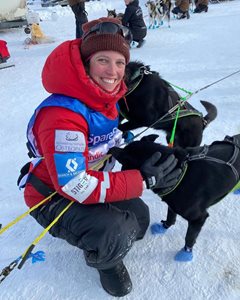 is not only a triumph in the world of sports – her entire journey is also an inspiring example of entrepreneurship. Her story beautifully illustrates how the traits of a successful entrepreneur – such as determination, strategic thinking, and risk-taking – can be applied far beyond the traditional business context. Now back home, Evelyne took the time to talk to us about her motivation and entrepreneurial mindset.
Evelyne, you successfully completed the Finnmarksløpet. How did you feel after such an incredible achievement?
Right after coming back, I felt completely empty. When you finish such a major project, you can suddenly fall into a black hole. I expected that to happen and had prepared myself for it, but I didn’t imagine the void would be that big. Now that I’m back home, life is slowly picking up again. There’s still a lot of work to do, so I’m keeping busy. But above all, I’m proud that I did it.
What motivated you to take part in such an extremely challenging race as the Finnmarksløpet?
One day, on a whim, I bought seven dogs and decided, “I’m going to Finnmark.” I hadn’t really thought it through. Only when I started entering races did I realise how competitive I actually am. Now I have to hold myself back. I know that as a beginner, I can’t start a race like the Finnmark expecting to finish in the top ten. I don’t yet have the experience or the team of dogs for that. I had to learn to set realistic goals for myself, which is tough when you’re ambitious.
In 2023 you had to withdraw just before the finish line. Did you approach things differently this year?
A race like the Finnmark is mentally exhausting for mushers, because you get very little sleep. The dogs rest for about 12 hours at a checkpoint, but you stay active the entire time. It’s that lack of sleep that makes many people give up – and that was the reason I had to stop in 2023, just 50 km from the finish line. At some point in the race, you start thinking it’s not going to work out, and then you have to make a choice: either you throw in the towel or you decide to push through. This year I was stubborn – I didn’t give up. And I crossed the finish line!
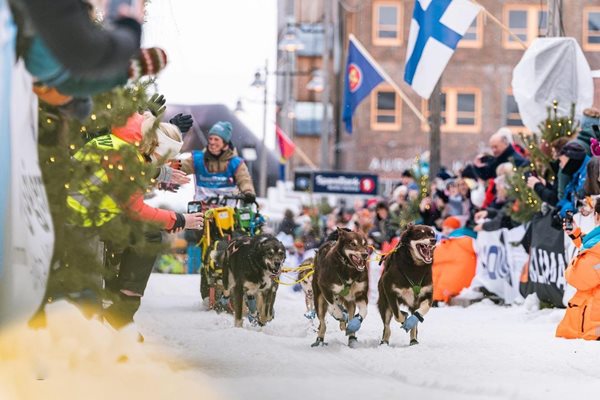
After the disappointment of 2023, how did you find the motivation to start training again?
This winter was tough. I moved house, which is never easy – especially when you have 14 adult dogs and 8 puppies to bring along. When the racing season started in January, I was already exhausted. The first races of the season went really badly, and I started doubting myself and my team. Was it worth even starting the Finnmark? A race like that demands huge amounts of time, money, and energy. If it went wrong again, I’d face the same disappointment as in 2023. But I couldn’t have forgiven myself if I hadn’t tried. My 2024 performance allowed me to end not just one, but two difficult seasons on a high note.
Does this success open up new opportunities for you?
It might, but I don’t know yet. Time will tell. I’ve only been racing with my own team for five years, while many mushers who compete in the 1200-km ultralong race have been doing it for much longer. To participate in that distance, my team still needs to grow stronger – both physically and mentally. That’s a time-consuming process.
As a competitive musher, what skills and competencies have you developed that you wouldn’t have learned if you had stayed in Belgium?
What I’ve probably learned most is self-discipline. You’re thrown into a very unforgiving world. You have to stay mentally strong, even when things aren’t going your way. A race like this is extremely black-and-white: one moment everything’s going great, and an hour later you think you’ll never make it to the finish. The art lies in finding the grey area in between. That’s a very valuable lesson – being able to take a step back and ask yourself what you can do to change things. As long as you stay focused, your dogs will too. But if you start doubting yourself, they’ll reflect that immediately.
Have you had to give up other things to pursue your dream so intensely?
Everything. We’re now entering the quiet part of the year, between March and August. I no longer have to train when I’m tired or sick, or when the weather’s terrible. I can finally have a social evening with friends if I want to, instead of being out on the sled again. But between October and March, that’s impossible. It’s six months without any real free time.
Fortunately, I have a strong support network around me, which helps a lot. But during that period, they’re busy too. We call each other, but we don’t see each other much. I have to learn to deal with that or find another way. I haven’t been back to Belgium since last summer. I’d love to go now that the busy season is over, but when? Someone has to take care of the dogs. It’s a complex issue.
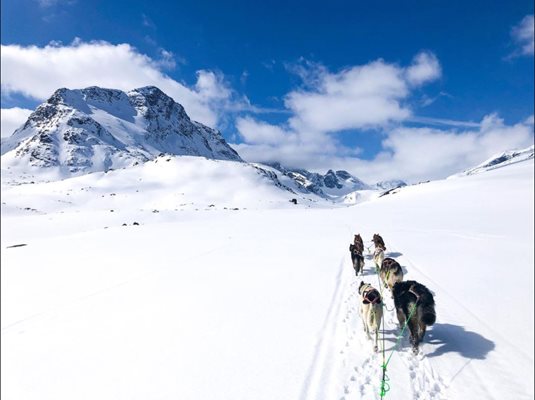
How do you decide what the next step is? How do you stay motivated to keep working toward new goals?
I took part in the shorter version of the Finnmarksløpet – the 600-km one. There’s also the ultralong version of 1200 km. I’d love to do that one, but I’m not sure how realistic it is. The logistics for a short race are already demanding, and for a longer one, they’re even tougher. Not only is the distance doubled – you also have twice as many dogs. That means more intensive training and a much higher financial cost. Those extra dogs all need to be fed… I think I need a bit more stability first and to build everything up gradually.
Are there other people in the racing world you look up to or draw inspiration from?
I know a couple of mushers who are now parents to four-year-old twins. I see the passion they still have for the sport and the sacrifices they make to keep competing. When I met them, they were finishing in the top ten at the Finnmark. The things they told me… I wasn’t sure if I had it in me to push that hard. I’ve always admired them and learned a lot from them. Even now, they’re my lifeline during races when things get tough. It’s thanks to them that I managed to finish the Finnmark this year.
What message would you give to others who are chasing their dreams like you?
Above all: just keep running into the wall and try again. Taking that first step is the hardest part, but dare to step out of your comfort zone to chase your dream. Things can go wrong, but then you can always decide to take another path. Not trying means you’ll never know if it could have worked.
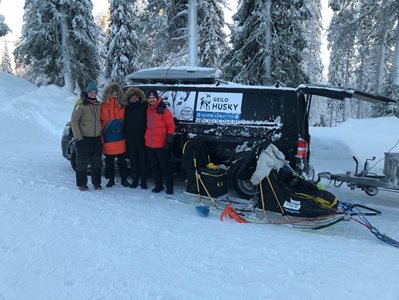
Evelyne’s Finnmarksløpet journey was featured in the third season of the VRT program Het Hoge Noorden. She also keeps a blog where she shares her adventures.