Connecting Communication: Hype or Here to Stay?
Connecting communication is a hot topic in the business world. But what does it really mean, and why is it important? Is connecting communication just a passing trend, or is it a lasting approach with real impact? And how can we use it to create a resilient and respectful organizational culture?
 Connecting communication, also known as nonviolent communication, is a communication method developed by American psychologist Marshall Rosenberg. The principle is simple but powerful: by seeking connection with your conversation partners, you reduce the risk of conflict. Rather than communicating reactively or judgmentally, the method emphasizes cohesion and collaboration.
To illustrate different types of communication, Rosenberg uses two animals: the jackal and the giraffe.
Unrestrained Jackal vs. Empathetic Giraffe
The jackal speaks from its own frame of reference and experiences. It interprets situations based on what it sees and hears, without stepping into the other person’s perspective. With limited empathy, jackal communication can come across as blaming, aggressive, or defensive, leading to misunderstandings and conflicts.
The giraffe, on the other hand, symbolizes empathetic communication. With its big heart and long neck, it can observe both its own needs and those of others. The giraffe is connected to itself and its environment, enabling open and understanding communication.
According to Rosenberg, each of us has both a jackal and a giraffe within us. While the jackal is often seen negatively, it can also be useful. Blaming or aggressive communication can act as an alarm, bringing underlying issues or needs to light. Responding to a jackal statement with giraffe communication creates real connection. But communicating like a giraffe is, of course, easier said than done.
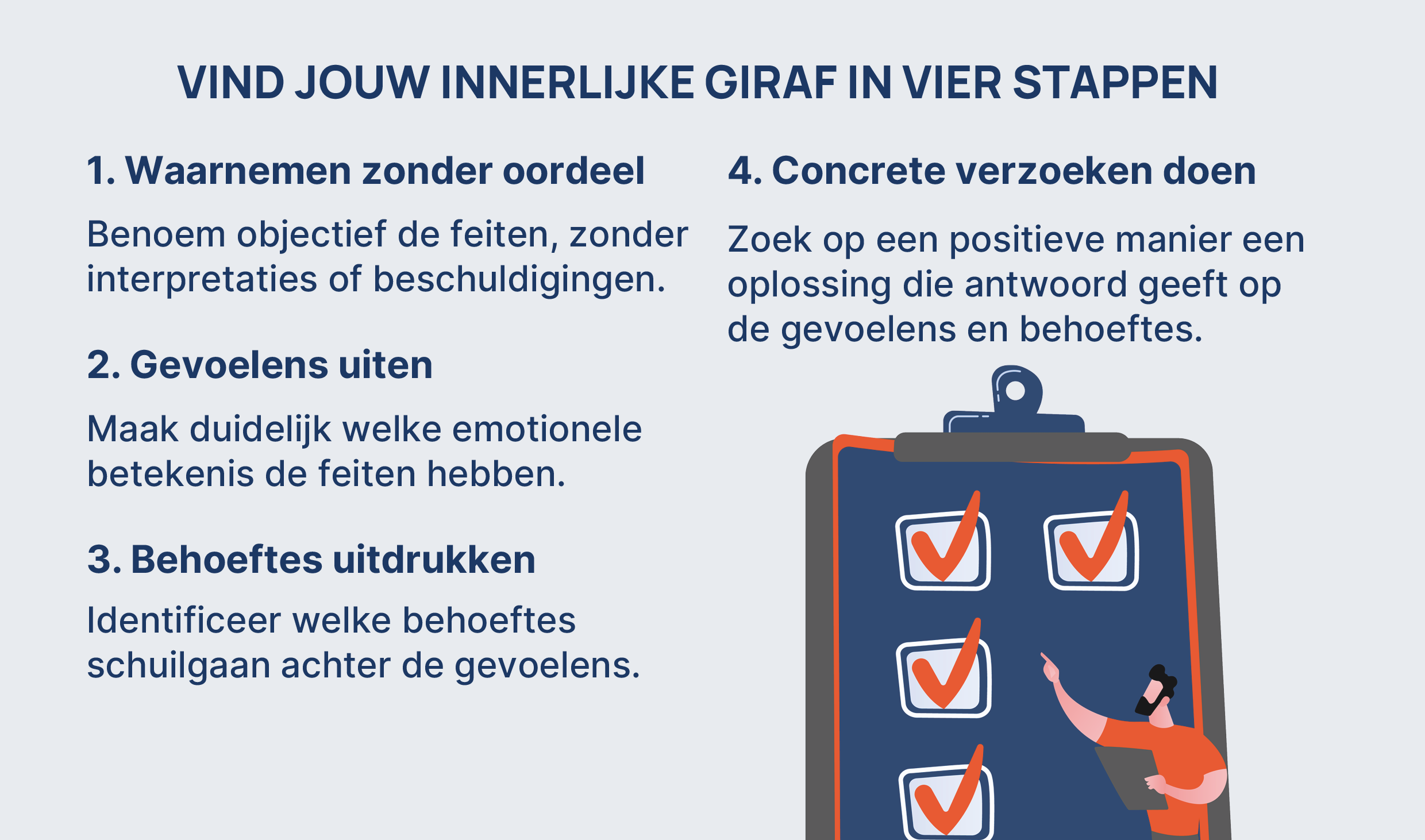
Connecting Communication in the Workplace
In practice, a conversation does not need to rigidly follow all four steps of the model. Still, it serves as a useful guide for (difficult) conversations, including in the workplace. Connecting communication focuses on listening, empathy, and clarity in discussions. When the underlying needs and feelings behind jackal communication are acknowledged, conflicts can be avoided or resolved constructively. Even more, by truly paying attention to one another, space is created for open and respectful feedback. Employees then feel safer sharing their ideas, concerns, and suggestions. A culture of trust and dialogue strengthens collaboration and forms the foundation of a healthy, resilient organization.
Each of us carries both a jackal and a giraffe within. The key is learning which voice to let speak in each situation. By finding the right balance between jackal and giraffe, we collectively build a respectful and effective organizational culture. At a time when workplace well-being and employee experience are gaining attention, connecting communication is not just a trend but an essential investment for a stronger, more connected organization.
WANT TO KNOW HOW CONNECTING COMMUNICATION CAN STRENGTHEN YOUR ORGANIZATION?
Contact Thomas Tielemans at t.tielemans@nxtcoaching.com or by phone at +32 490 44 93 85.